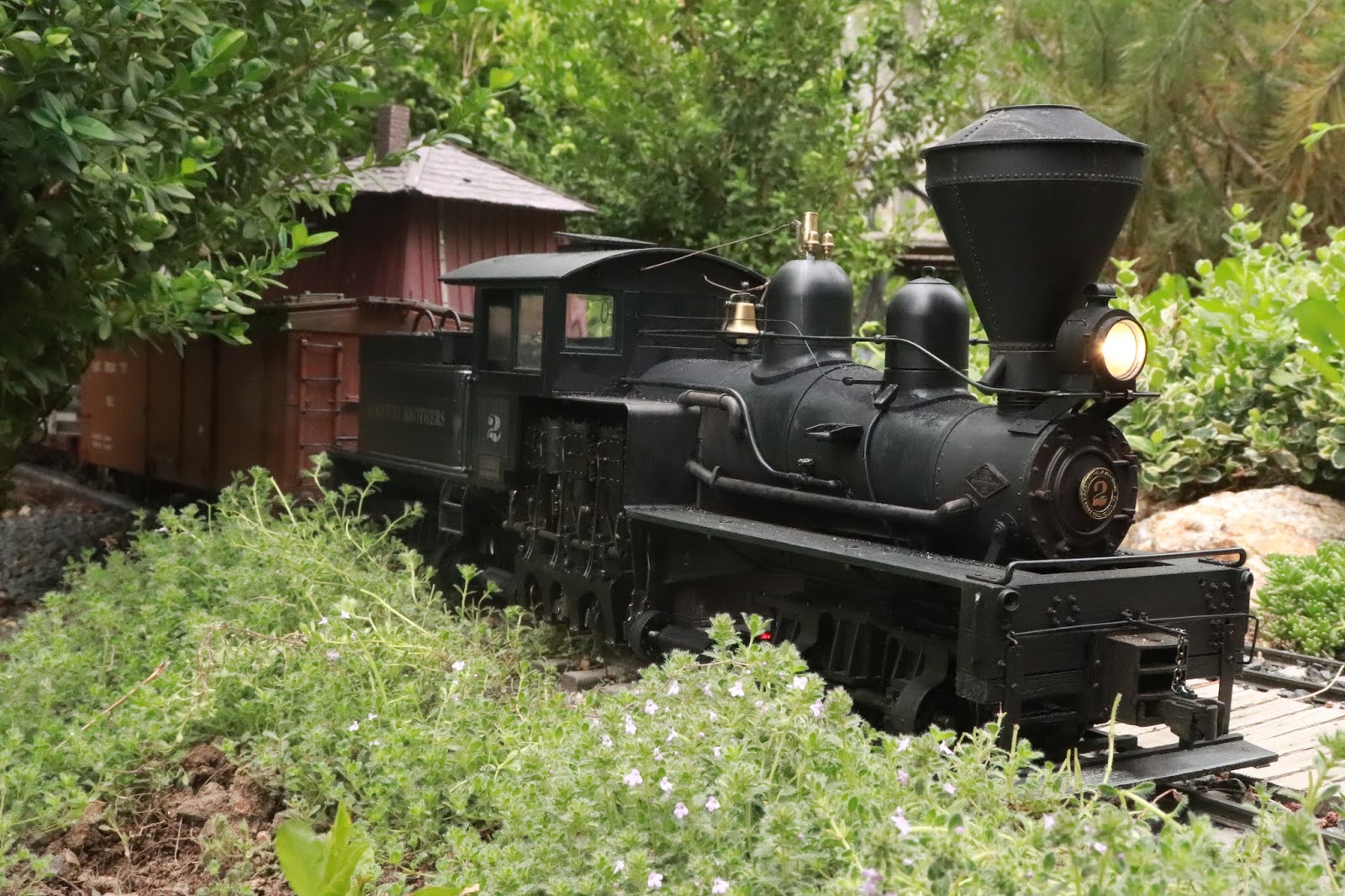
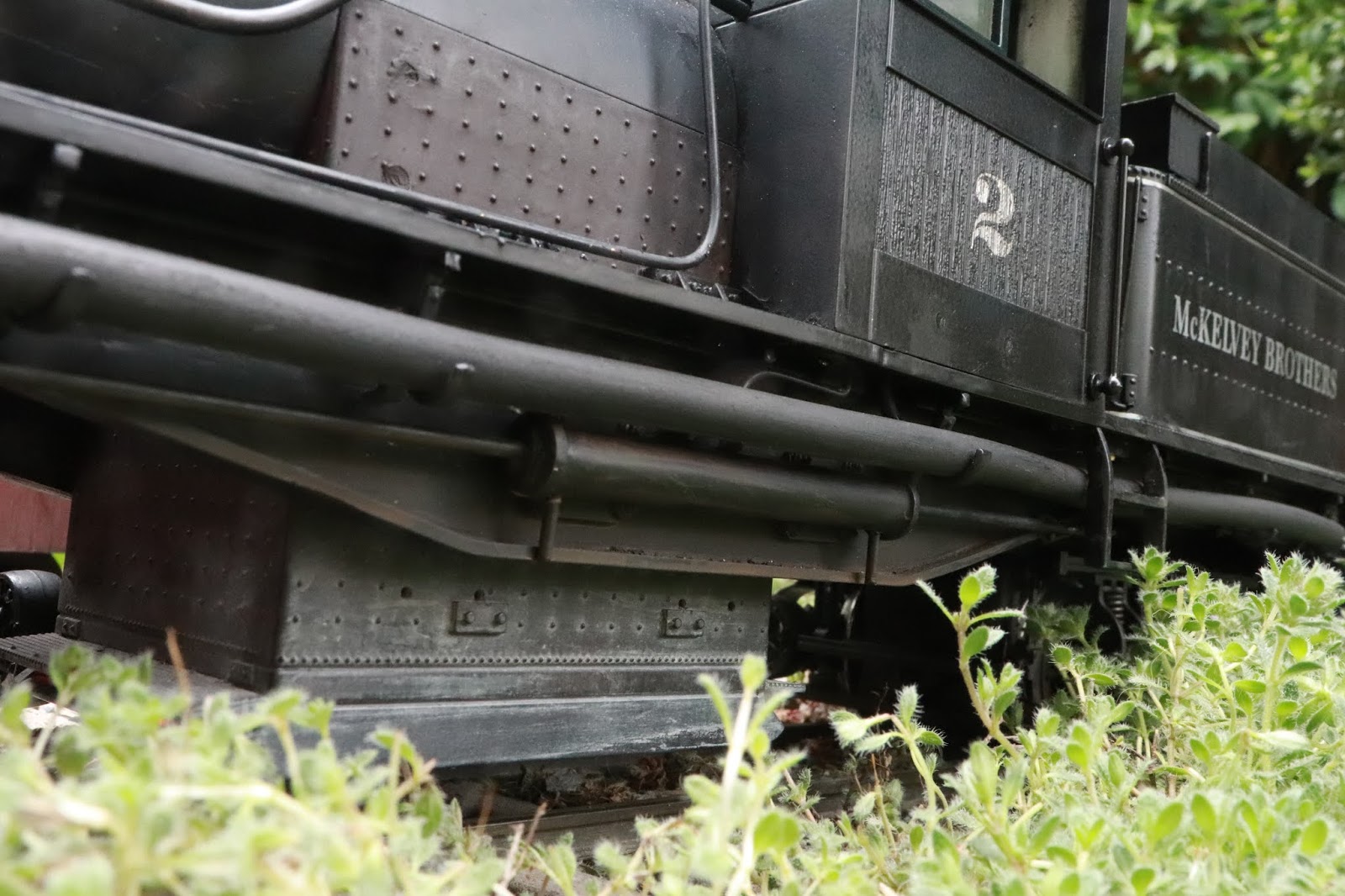
Tuscarora Railroad

The Tuscarora Railroad is a 1:20.3 garden railroad located in suburban Denver, Colorado. The railroad is based on the East Broad Top RR which still operates today as a tourist line in Orbisonia, PA (south-central PA).

Name:
Location: Denver, CO

Monday, December 5, 2011

EBT #7


In 1881, the East Broad Top RR found itself in need of a new locomotive. Naturally they turned to their good friends in Philly at Baldwin to see what they could do. Baldwin delivered a new 2-8-0, built to the same drawings as the D&RGW's "70-class," later designated their "C-19" locomotives. This loco featured 37" drivers, and developed nearly 19,000 pounds tractive effort--more than twice that of any of the EBT's other locos. The loco, named "Aughwick," would serve on the railroad until 1913, when it was sold to the Ohio River & Western RR. It survived on that railroad until the line ceased operations in 1931, having the dubious honor of pulling the last train.

Number 7 went through a series of mechanical and cosmetic changes over the years. The photo above shows the loco shortly after delivery. In the mid 1890s, the loco received new main rods that connected to the third driver instead of the second. Some reports indicate this was done so to try to smooth the ride. Whether this was effective or not is lost to history, but #7 appears to never have been known for comfort.

In the late 1890s, #7 ran headfirst into #8, causing significant damage to the front ends of both locomotives.

But perhaps the most notable change to #7 came in 1908, when it was being stored inside the EBT's paint shop when the shop burned down.


Damage was significant, as this photo shows. Seemingly all of the wood parts on the loco were badly burned. The tender tank appears to have suffered a great deal as well, though it's unclear how much damage the tender frame would have incurred.

After the fire, the EBT rebuilt #7, with a new steel cab--a curiously tall affair presumably built by Baldwin, as it strongly resembled the cab on #11, which they were building for the EBT around the same time. Unfortunately, no photos of #7 in service on the EBT after its rebuilding have come to light, so its post-fire appearance remains something of an enigma.


This is the "next" known photo of #7, taken after it was purchased by the OR&W. It was originally numbered #14 on that railroad, and later changed to 9669 after the Pennsy took over and renumbered all the locos.

What's not known is when the tender behind #7 was changed. The tender that's seen behind it on the OR&W has all the hallmarks of a Pennsylvania RR tender as opposed to a Baldwin tender. Most likely, the EBT kept the original tender (maybe putting it on a new frame after the fire), but the OR&W replaced it with a larger capacity tender.

The Model

I've always liked #7, and when Accucraft came out with their D&RGW C-19, I was seriously considering saving my pennies for one. Alas, when I saw the model, I realized I'd have to make changes to many of the details to get it to resemble the EBT's locomotive. That's normally not a problem for me, but there was just something about buying a $2,500 locomotive only to not use the vast majority of it that didn't sit well even with me (the CFO notwithstanding). So, despite my desires, that option was out.

The next option was to scratchbuild one. Only one problem... I hate scratchbuilding locomotive drive mechanisms. Yeah, I can do it, but it's just not the tops of my "fun" list. So anything that requires such an effort gets bumped down below other projects that don't require such tedious measures.

Enter Barry's Big Trains. I had always heard good things about the quality of his drive mechanisms, but didn't have any firsthand experience with them until I built my EBT #3. That, a subsequent remotoring of TRR #3 with one of his replacement gearboxes, and tweaking a friend's 4-6-0 chassis sold me on the quality of his stuff. The things are about as top drawer as you can get. Strong motors and gears, and very smooth operation allowing for very slow speed starts and stops. So, after a short period of boredom not having a locomotive project to work on, I e-mailed Barry the drawings for #7, and ordered a custom chassis from him.

After a few months wait (well worth it), this is what arrived in my mailbox. The drivers are Barry's custom-cast 36" drivers--technically 1" too small, but you have to consider that locomotive drivers were frequently shopped and resurfaced. It wasn't uncommon for driver diameters to vary as much as 3" to 4" from what was specified before the drivers had to have new tires fit to them.


Next, what to do for the cylinders, valve gear, and all that fun stuff. As luck would have it, I had a somewhat surplus locomotive that could be used for this project. My model of "old" Tuscarora RR #2 (as opposed to the 1920s version documented elsewhere in this blog) hadn't turned a wheel in quite a while. In truth, I was never 100% satisfied with how that loco turned out, and after gutting the old R/C electronics out of the tender, I was on the fence about what to do with it. After doing some quick measurements, I discovered that the cylinders, valve gear, and domes from that loco would be almost spot on for #7. So, #2 got scrapped, with its parts now being used for #7.


If I were to model #7 as built, I could have used the main rod from the 2-6-0. Since I'm modeling the loco as it presumably appeared after the 1908 fire, I needed a longer main rod. By happy coincidence, the main rod from the Bachmann 4-6-0 was nearly a perfect fit. It's actually about 1/8" too short, but it's not noticeable. The only thing is that the crosshead nearly touches the back of the crosshead guide support (whatever that's called--it's escaping me right now).


Here's a view inside the chassis at the valve gear. My original thought was to just use the Bachmann valve gear as it came off the locomotive, but there were clearance and fitting issues to deal with. When combined with the fact that no one would actually see the valve gear because it was behind the frame, I decided to simplify things, and just modify the eccentrics so they simply moved back and forth without any kind of working reverse mechanism. I also had to grind the top of the rods down so not to rub on the cap of the frame.


The boiler is formed from a section of PVC pipe. The pipe itself is too small, but the PVC pipe couplings were the right diameter. So I cut a bunch of rings out of some couplings, then placed them at points where domes, handrail stanchions, and other fittings would be attached to the boiler. The aluminum foil tape at the end is to simulate the boiler jacket folding down over the lagging.


Here's the progress to date. The cork wrapped around the smokebox is to expand that to the proper diameter. The black tubing for the smokestack, headlight, and pilot are just fillers for aesthetic purposes. They'll be replaced by pieces that better match the prototype.

More updates as events warrant.

Saturday, August 20, 2011

EBT #12 arrives on the Tuscarora RR


The Prototype

East Broad Top #12, built by Baldwin Locomotive Works in December, 1911. Delivered to the railroad in January, where despite derailing on its maiden trip, became one of the favorite locomotives on the railroad. It ran until 2000 when mechanical issues sidelined it. It sits quietly in the Rockhill Furnace roundhouse for some glorious day when the funds are available to begin its restoration.

The prototype has 48" drivers, and developed 22,000 pounds tractive effort. It's a bit smaller than a K-27, though the boiler sits higher due to the larger diameter drivers. As seen in the photograph here, the locomotive was delivered to the railroad in Baldwin's "standard" olive green paint (reportedly a very dark green that only looked green in bright sunlight), plannished iron boiler jacket, and "chrome yellow (orange)" lettering. (Chrome yellow was a color that could vary from yellow to a very deep red-orange.)

The locomotive was an outgrowth of EBT #11, a 2-6-2, and the first EBT locomotive to sport a trailing truck. This advancement allowed for a much wider firebox, thus more efficient steaming. Number 12 proved so successful that it spawned 5 additional mikados on the EBT. Numbers 14 and 15 were a little bit larger with a higher capacity tender, and numbers 16 - 18 were larger still, with superheaters and piston-valve cylinders--every bit as modern as their standard-gauge contemporaries.

The Model


Accucraft's long-awaited live steam EBT mikado finally arrived here in Colorado last week, after over 4 years of waiting from when it was first announced. When it arrived, I was very impressed with it. Compared to published drawings, the locomotive was very close to the prototype (within 1" on most dimensions) and it just captured the look of an EBT mikado very well. (And it ran well to boot!) Accucraft decided to offer the model in the "tourist" paint used by the EBT, resplendent with brass boiler bands, white trim, and red cab roof. While certainly attractive, and easily argued that it's the paint worn by the locomotive for over half its life (from 1960 to present), it's not accurate for the time period I model--the early 1910s. So, after I finished shooting all the photos and video for its review in Garden Railways, it was straight to the paint shop for a proper dose of "reality."

A few issues popped up that needed to be addressed. First, if I were to take the locomotive all the way back to its "as built" appearance, I'd have to remove the generator and one air pump, which would mean doing a bit of re-plumbing with regard to the air lines. Certainly nothing I couldn't do, but did I really want to? Second, I'd want to use the dark green paint I've been using on my other EBT locos of that time period to match Baldwin's olive green. That would mean repainting the loco pretty much from head to toe. Again, I could do it, but then I'd have to re-letter the loco. Now, foreseeing this issue a few years ago, I had some custom dry transfers made up for a bunch of EBT locos. Unfortunately, I made the "12" on the side of the cab the same size as the numbers on the cabs of the other EBT mikados, which it is not. It's smaller. So if I were to re-letter the loco, the numbers would be wrong, and that bugged me. Also, I like working headlights on locomotives, and the only way to get power to the headlight to this locomotive is to run a wire outside the boiler to it. So a visible electrical conduit would be necessary. If I backdated the loco all the way back to 1911, the conduit would not be prototypical. However, if I modeled the loco as she looked in the 1920s, then I could use the conduit that's on the prototype to run power to the headlight. So, 1920s it was, then. While I have no historical proof, I'm making the presumption that in the 1920s, the loco very likely still had its planinished iron boiler jacket, and that the dark green paint would either have weathered to a black with 10 years of coal dust, etc., or would have been repainted black by the shop crews as part of their routine maintenance. That allowed me to keep the factory finish on the cab and tender.


After two evenings of work, #12 emerged looking quite a bit "younger," if looking older at the same time.


If there was one "novel" technique I used on this loco, it was my technique for doing the plannished iron jacket. I usually use one of two methods for simulating this material; either blackened brass sheet or Testors' "Model Masters" buffable Gunmetal paint. Both give a very close impression of what a true plannished iron boiler jacket would look like. The problem on this locomotive was that for me to do either of those techniques, I'd have to strip a bunch of stuff off the boiler, and I wasn't about to do that. So, I experimented with powdered graphite; the stuff that comes in small tubes for lock lubricant. I'd used this before for smokeboxes on my live steamers with fairly good results. I swabbed the graphite on the boiler, then rubbed it in with a paper to even the finish out a bit. Then I painted over it with a clear acrylic to seal it in place. The result is very convincing. It's a bit darker than the gunmetal paint, but still has that nice reflective quality to it.


The smokebox got painted black. I started with a coat of Badger's "ModelFlex" Gloss black. This is really good paint, if you've never used it. It's designed to be airbrush-ready, but brushes on very well, often covering in one coat and leaving no brush strokes. It sticks to the factory paint very well, though I did have to scuff up the white trim with some steel wool so the paint would stick to that. Once that was dry, I weathered it with flat black paint. (The Folk-Art brand flat acrylics I use didn't stick to the factory paint worth a darn, but stuck to the gloss black paint very well.)


I also used the same paint on the rims of the wheels. This is always a bugger to get paint to stick to, because the ballast reaches up and scratches the paint no matter what. But this stuff sticks very well. It also sticks well to the valve gear, which got painted black to match the prototype.

Some other views of the loco:


I can't take credit for any real cosmetic work on this model. Accucraft did such a good job with it, there was really very little for me to do in terms of actual "modeling." I added some details, but that was about it.


First, there was the extension rods to reach the injectors. Many locos have the injectors inside the cab where the engineer and fireman can physically reach them. The EBT ran control rods to them.


I also added sanding levers to each of the two sand domes. These were on the engineer's side only.


I replaced the couplers with Accucraft's 1:32 couplers, since they scale out spot on for the 3/4-sized couplers used by the EBT. For the front, I just cut off the shank, drilled a hole, and stuck it in. There's not a lot of room for side-to-side swing in that front pocket anyway, so I figured I wasn't losing much if anything. It's really no more rigid than the stock coupler. On the rear, I modified the stock draft gear to fit the coupler pocket, so I have more swing on the tender.


The ModelFlex paint is very thin, so when I painted the plates on the front of the two airpumps, it settled down into the valleys, leaving the raised parts to be easily read (with a magnifying glass). It really helps those plates blend into the rest of the model.

And finally, some shots of #12 with a proper train behind her. (I must confess, I didn't actually steam the loco for these photos.)

Westbound on the north leg of the Neelyton wye


Coming into Blacklog


And eastbound again, headed back to Neelyton


Next is to install the R/C for the throttle and direction, and to wire the headlight and possibly the class lamps. That'll probably be a fall/winter project. For now, the locomotive has that "workhorse" look I was after, capturing the essence of the EBT mikados in regular service.

Monday, May 23, 2011

A Little Press in the Gazette

The Tuscarora Railroad was featured in the June/July 2011 issue of the Narrow Gauge and Short Line Gazette. For those unfamiliar with this publication, it is arguably the premiere publication for narrow gauge model railroad enthusiasts, and features some of the highest-quality modeling you'll ever find in model railroading. I consider it quite an honor for the TRR to be featured in its pages.

Of course, print has its limitations--the most pressing one being space. I compiled over 50 photos for consideration when I put my article together, and pared that down to around 30 or so when I finally submitted it. The article pulled around a dozen of those shots, leaving many left "on the cutting room floor" as they say in my business. (I'm really not sure what the print equivalent of the cutting room floor is, come to think of it...)

Fortunately, I'm not so limited here, so without further ado, I swept up the proverbial cutting room floor, and present to you the photos that didn't "make the cut."

Tuscarora RR 2-8-0 #3 leads a short train into Blacklog


EBT Caboose #26 was built by the railroad from a surplus flat car in 1905. Newspaper accounts allude to it being quite a rough ride, and at some point in its life, it was fitted with surplus passenger trucks presumably in an attempt to smooth out the ride. It would be rebuilt--possibly at the same time--with a round roof and no center cupola, and would last in work service until the early 1950s.


Somewhat uneven and weed-grown tracks are the norm for the TRR's right of way. Speeds are low anyway, so this typically isn't too much of an issue. Here, TRR #3 brings its train into Neelyton. The bridges in the foreground cross Trout Run.


EBT caboose #26 brings up the rear on a train of empty hoppers being returned to Rockhill Furnace, so they can be filled once again at the mines in Robertsdale.


TRR 2-8-0 #3 running extra through the woods between Shade Gap and Neeleyton.


East Broad Top 2-6-0 #1--the EBT's first loco--prepares to leave Blacklog with a short passenger train.


This time, it's Tuscarora Valley 4-4-0 #5's turn on the daily passenger run.


Tuscarora Timber Co. #4, a Heisler, pulls into Blacklog late one evening. Usually the Heisler works the logging lines which feed into the TRR along the trunk route from Blair's Mills to Burnt Cabins, so its appearance on the Shade Gap Branch is a bit of a rarity.


TRR #3 has just spotted a flat car with fresh-cut timbers for the Beers & Green Woodworking shop at Blacklog. Beers & Green is primarily a pin mill, making small pins and dowels, but also turns out other finished wood products as demand warrants. A Wesley's Creamery truck waits at the Blacklog Depot to pick up a delivery of fresh cream.


East Broad Top 2-8-0 #3 pulls some empty wood hoppers west out of Neelyton, bound for the EBT. These hoppers are near at the end of their careers, as the EBT is busy replacing them with modern steel hoppers.


EBT #3 continues westbound, approaching Three Lick Creek before stopping at Shade Gap.


Fast forward a few years to 1927, and a rebuilt TRR #2 pulls its freight into Shade Gap. TRR #2 had just been in a wreck and was sent back to Baldwin for an overhaul.


TRR #2 leaves Blacklog.


There are also two videos I've posted on YouTube which I haven't mentioned here yet:

A Trip on the Tuscarora Railroad

Morning Mail on the Tuscarora Railroad

Monday, March 28, 2011

Good Grief! Is it Spring already???


 someone please tell me where Winter went?

My "to do" list for the winter

1) Bring in buildings and fit with LEDs for lighting.
2) Do some "urban planning" in Neelyton to take advantage of extra space gained from the plant that died.
3) Finish the 3 stillborn passenger car projects sitting on the shelf for the past 4 years.

My "to done" list for the winter


Oh, wait...


Well, in honesty, it hasn't been a totally wasted winter, but none of my "to do" list has yet been done. My LED lighting experiment has proven successful, and I'll write more on that in the future once I'm able to take photos of what I'm doing. Suffice to say, the Tuscarora RR is going green when it comes to lighting.


Okay, I have been doing some work. Hopper 162 in the background of this photo is chronicled in my last post, along with EBT 3rd #2. I've been doing some work, just not what I set out to do. The two hoppers in this photo are two more examples of projects that crop up to keep me from doing what I "said" I'd do.

The hopper on the left is an Accucraft 1:20.3 3-bay hopper. It just came onto the market in January of this year, and is a fairly accurate model of the EBT's ubiquitous 3-bay steel hopper. (There are some minor issues, but nothing that would keep me from proudly running a string of them.) The "biggest" cosmetic change to them is replacing the non-prototypic "C" channels that run across the middle of the car with proper lengths of rail. This is a pretty simple change to make. I just used a razor saw to cut out the old, cut off the "L" brackets to the side of the car, and then cut new lengths of code 250 rail to sit on top. I also changed the lettering of the car, as Accucraft's lettering isn't 100% accurate. I had given them correct artwork for the "acorn" herald and lettering, but for whatever reason they didn't use the artwork for the lettering. So, I sanded off all of the lettering but the acorn herald, and relettered it with proper artwork. The dry-transfer lettering I used is available from the Friends of the EBT Company Store.

The car to the right is the Bachmann 2-bay hopper, also based on an EBT prototype. The prototype is one of 4 2-bay hoppers built in 1930 specifically for the ganister rock quarries. The Bachmann model is fairly accurate for that car as well, but the lettering was all wrong. So, a little steel wool and denatured alcohol to get rid of all the original lettering, new dry transfers, and some weathering, and viola!

So far, I've done 4 hoppers (three 2-bays and one 3-bay) and will be adding a few more 3-bays to the roster over the coming months.


The other project I've been doing over the winter is modernizing my control systems. I've abandoned the old RCS "Elite" pushbutton control systems in favor of the newer high-end control systems from AristoCraft (Revolution), Airwire, and QSI. I particularly like the added functionality of these new systems, specifically adjustable momentum settings for smooth, slow starts and stops (though switching gets a bit more challenging) and the interaction these new systems have with the more modern sound systems from Phoenix and QSI. It adds a whole new dimension to running.

Currently, I've got the Revolution systems in my locos that have the "old" Sierra sound boards. The Airwire system drives my Phoenix sound boards, and the QSI is a throttle/sound board in itself. The benefits of each of these systems is a blog post unto itself, so keep checking back for that. Suffice to say there's no one clear "winner" system, and with each manufacturer continuing to up the ante, I don't think there will be any time soon.

I have managed to get out and run some trains over the past few weeks, even do a bit of early-Spring trackwork to take care of some trouble spots. I don't foresee a whole lot of other maintenance in terms of the railroad itself this spring, though the dry winter has taken its toll on some of my plants. I know I'll probably have to replace about a dozen shrubs. (Where'd I put that stupid receipt???)

Monday, January 10, 2011

Recent Projects

Okay, so it's been two months since I posted anything here. It's not as if I haven't been busy in the workshop, though. Anyway, I'm writing this from a hotel in Durango, Colorado, which--as most know--is home to the Durango & Silverton RR. Alas, the trains aren't running on Mondays or Tuesdays, and even if they were, I don't have time to ride. (Oh, if I did, though... I am squeezing a trip to the roundhouse museum tomorrow morning before I leave town, though. It's not a total wasted trip.)

However, since I have absolutely no interest in what's going on on the BCS championship game that's providing background noise at the moment, (is it wrong that I want the Ducks to win for no other reason than they're named the "Ducks?") I figured it high time to update what's been going on in the EBT shops over the past few months.

First off, a little something to make things move...


I found this photo on a recent trip to the East Broad Top. It's the first photo I've ever seen of what would become the EBT's 3rd #2 while it was in service as the shifter at the Rockhill Furnace. (A job it would have for only a few years, as the furnaces shut down shortly after it arrived.) I had recently traded for a Bachmann 0-4-0T, and this was just the perfect project.
I wasn't expecting this to be an exact copy, because I didn't want to have to do such things as build a new cab or change the domes. But with a little bit of work, I got it pretty close.

The biggest cosmetic change was shortening the tank so it was no longer even with the front of the smokebox.

The tank itself was rearranged, too, so the bell and forward sand dome switched places. A thin wrapper of styrene sheet covered the seams nicely. The aluminum tape underneath holds the lead shot in place inside of the domes. I'm using a single 7.4-volt Li-Ion battery to power this, but to fit it, I had to remove the stock weight. It's so light that I need to add more weight so the loco actually pulls more than its own shadow.

The boiler and cab got lowered, too, bringing it around 1/8" closer to the ground. This was actually a surprisingly easy chore.

(Auburn just won. Bummer. Wait, I don't really care.)


New pilot beams complete the loco. This loco is manually controlled. It's my "someone's here who wants to see something run" loco. No pilot wheels to derail on switches, no need to have to carry a controller. Just put it on, turn it on, and set the speed. It's also got a MyLocoSound soundcard in it, and the switch on the right will blow the whistle.


Here's the "guts" of the electronics under the boiler.


Painting was fairly simple. I didn't need to paint the cab, since it was already black. The rest got painted with either Krylon's flat black primer or their semi-flat black. I must admit to being less and less enamored of Krylon's reformulation. It's definitely not quite as good as their old stuff.


Decals came off of my ALPS printer, using a font that was about as close as I could find to the original lettering. It's not perfect (do you know how much of a royal pain it is to find simple fonts on the web?) but it's close enough for me. I really hate decals, but sometimes they're a necessary evil.

Next came a bit of weathering, using my usual application of washes.


Finally, the finished product, ready to head out on the line.


The other "lastest project" is something of a conjectural model. Well not so much conjectural in terms of being purely freelance, but more in terms of it having roots in the prototype, but with a few liberties taken.

It started when I found an AMS D&RGW refrigerator car on sale at a really good price. It was the same length as one of the EBT's early "miners'" coaches, so I figured a new roof, some cut some windows in, and I'm all set. Alas, once I got the car home, I discovered the roof is all but permanently attached. So much for that project. So, what to do with a refrigerator car on a railroad that never had them?

The answer came not from ice, but from water. The EBT did have "water cars." These were ordinary box cars with roof hatches cut into them and drains installed in the floor for carrying water. In the dry summer months, the creek up in Robertsdale would sometimes not supply sufficient water for the boilers that powered the mine equipment, so the EBT loaded water into these box cars and ran them up the line. This happened as early as 1904, though it's likely the practice was older than that. The box cars would be sealed on the inside, some sort of baffling arrangement installed, and the car filled about 1/3 full with water via the roof hatches. Once in Robertsdale, the drains would be opened and the water drained.

In the 20s and 30s, these water cars were used for loading clay from the Shirleysburg clay mine. Again the roof hatches made for easy loading of the clay, though it was removed via the side doors.

So, I had this refrigerator car that was pretty in size to the EBT's "2nd-generation" box cars (though it sits around 6" too low), but has these roof hatches. Well, we don't *know* that all the EBT water/clay cars only had two roof hatches, one cut into the center of each end. Why couldn't the EBT have had borrowed from other railroad practice (they were good at it), and build a car with 4 hatches instead? Thus an idea was born.


So with a little bit of work, all the trappings of a D&RGW refrigerator car were removed, to be replaced with details consistent with an EBT 2nd-generation box car. After a bit of paint and weathering, this is what came about.


The lettering is from the FEBT Company Store. It's sold as hopper car lettering, but the EBT used the same style of lettering on all their freight cars.


Weathering is done with my usual mixture of acrylic washes and Bragdon's powders. These powders have a binder mixed in, so you don't need to seal them.


A little dry-brushing brings out some more detail, such as simulating chipped paint on the tin roof panels. All in all, not too bad for a "plan B."